
What Culpeper County Deed Records Include
The Circuit Court Clerk records two broad kinds of paper in Culpeper County. One group transfers land. The other affects an interest someone already holds. Names matter here. Deeds and related land records are indexed by the parties and the parcel description rather than by street address. A house number alone will not carry a search far. When an instrument name is unclear, the Clerk's staff can say what the document is called locally.
| Deed Type | What It Does | Common Use |
|---|---|---|
| Deed | Conveys the interest stated in the instrument | Purchase, gift, or other transfer |
| Deed of trust | Secures a debt against real estate | Loan or refinance |
| Release / satisfaction | Records that a secured claim was released | After payoff or reconveyance |
| Trustee or fiduciary deed | Conveys land through a trustee, executor, or administrator | Trust, estate, or foreclosure transfer |
| Plat, easement, or boundary agreement | Maps lots or states a land-use or line interest | Subdivision and boundary research |
A deed conveys whatever interest its granting language states. Other instruments do different work. A deed of trust secures a loan. A lis pendens flags a pending dispute, an easement records a use right, and liens attach claims. A full title review follows conveyances and everything recorded after them. Among its holdings the Circuit Court Clerk lists deeds, deeds of trust, releases, liens, judgments, plats, and related Culpeper County land records.
Culpeper County Deed Index and SRA Images
Virginia's Secure Remote Access service, or SRA, delivers land records statewide through the COVERS system. A Clerk may allow free index-only access. Images are another matter. They are reserved for subscribers the local Clerk authorizes under an agreement, and fees apply. Confirm search controls and date ranges with the Clerk rather than assuming them. From a likely result, copy the parties and recording date. Copy the instrument type too. Include the book/page or instrument number. That reference opens doors. If an image will not load, ask about subscription terms. The courthouse records room is another option. A missing image does not mean no deed exists. Search releases, assignments, easements, plats, and liens when the question reaches beyond the conveyance itself. The Virginia SRA page explains both index-only and authorized image access.
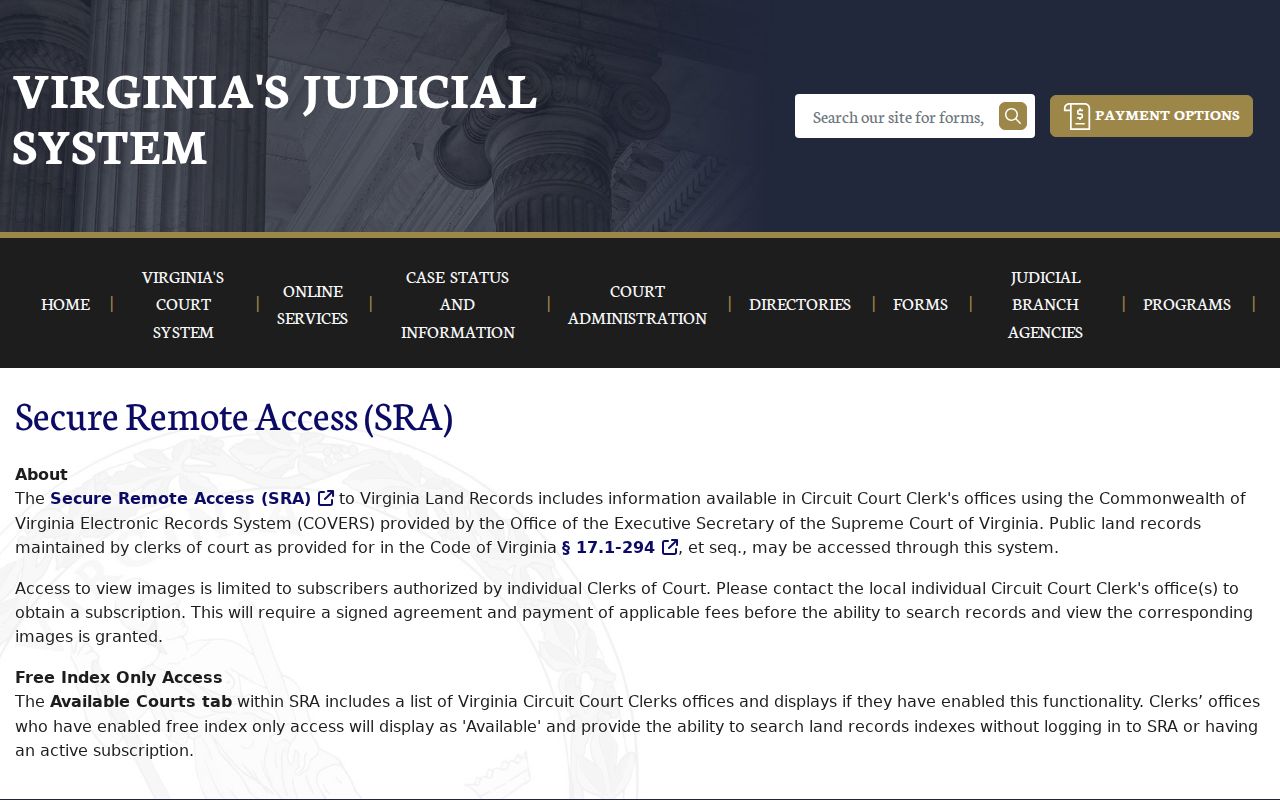
An index entry points to an instrument. Only the image holds the full terms and the land description, so plan on pulling the recorded pages before drawing conclusions.
Culpeper Clerk Recording Hours
The Culpeper Circuit Court Clerk’s office sits at 135 W. Cameron Street, Culpeper, VA 22701, and the phone number is 540-727-3438. Doors open at 8 a.m. and close at 4 p.m. Land recordings must arrive by 3:30 p.m. In-person, mail, and electronic recording channels are all listed by the Judiciary. Fax is not listed as an accepted method for land records.
Call the Clerk before mailing any instrument. Confirm the current recording fee, return instructions, and document requirements. No local fee schedule publishes a copy or recording amount. A counter search goes faster with key details. Bring the GPIN, grantor and grantee names, the likely year, the instrument type, and any known reference. Those details keep same-name results apart.
The Culpeper Circuit Court page lists local contact and recording details.
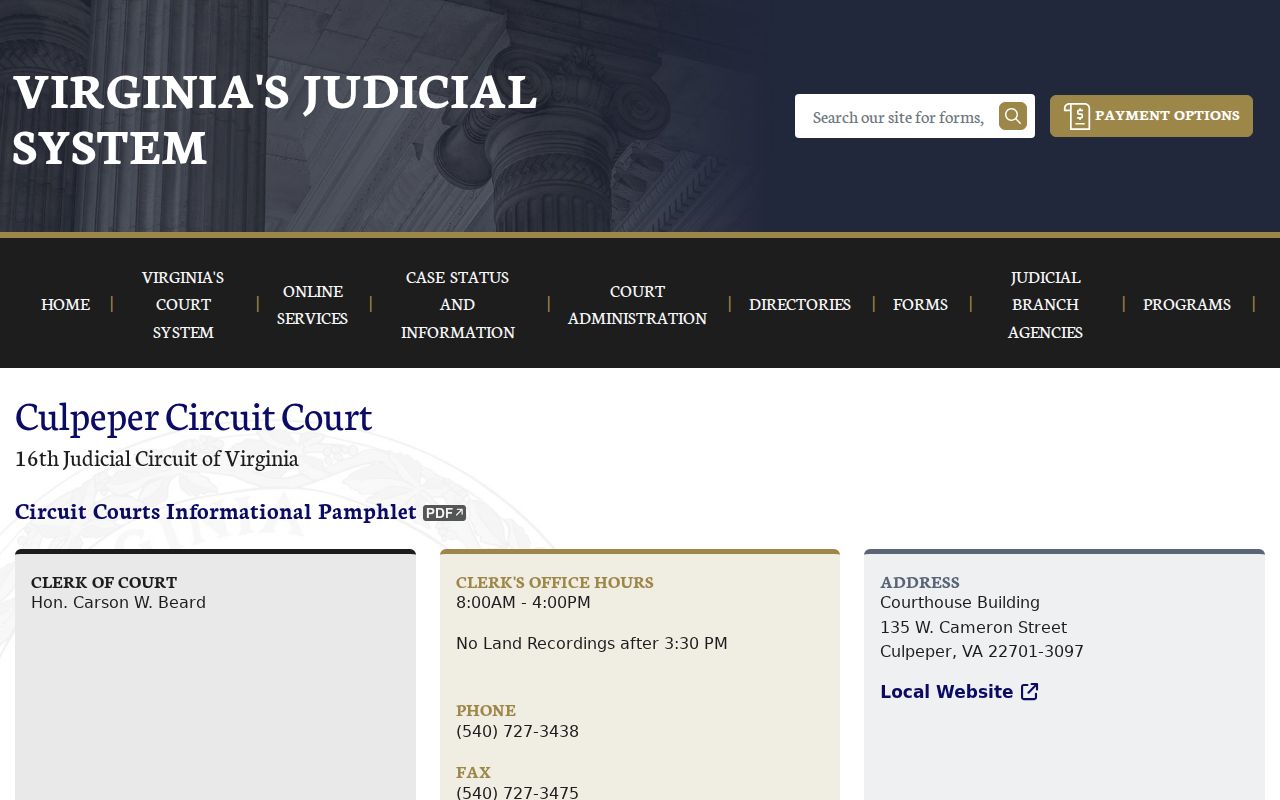
Plan any filing around the shorter land-record window. The Clerk keeps other business open through the posted closing time, but recordings themselves cut off earlier.
Using Culpeper County’s Party Index
A grantor conveys an interest; a grantee receives it. Tracing a Culpeper County deed record works backward. Start with a known owner or parcel, locate the acquisition instrument, and read the grantor named in that deed. That grantor was often the previous owner. Search the same name as a grantee to find the earlier acquisition, then keep stepping back deed by deed. Match every result by legal description and recording reference so a shared name does not drag the chain onto a different tract.
- Find the current deed and note the grantee, grantor, date, and legal description.
- Search the party as a grantor to find a later conveyance, or as a grantee to find an earlier acquisition.
- Compare lot description, acreage, adjoining owners, and book or instrument reference across each entry.
- Try spelling and name forms, including initials, company endings, trustee names, and fiduciary titles.
- Grantor
- The party transferring the interest described in the instrument.
- Grantee
- The party receiving that interest.
- Chain of title
- The sequence of recorded transfers tied to the same land.
- Book/page or instrument number
- A Clerk reference used to locate a recorded item; confirm which one the index displays.
Culpeper County Deed Records for Trusts, Releases, and Liens
Culpeper County land records hold far more than deeds that convey ownership. A deed of trust secures a loan. An assignment shows a change in the secured party. A release records that an instrument was satisfied. Judgment liens, mechanic's liens, tax liens, easements, and lis pendens each touch a property review differently. Never assume a claim ended. Read the later instrument itself. A tax payment history does not release a deed of trust, and one release does not clear unrelated liens. Search the named parties and parcel description first. When a recorded notice points to a lawsuit, move to the court docket. The Virginia Judiciary warns that circuit-court case coverage is selective. Contact the local Clerk to learn whether a file is current, archived, sealed, or held on paper. Culpeper Circuit Court property matters can range from foreclosure and lis pendens to partition, quiet-title and boundary disputes, mechanic's-lien enforcement, deed correction, and assessment appeals. A case-information result may identify a proceeding. The two answer different questions, though. Match the parties and parcel description across both before treating a case entry as a change in title.
Historic Culpeper County Lot Descriptions
An old Town of Culpeper deed rarely matches a modern listing. Early deeds describe land differently. A lot might be fixed by its block, the adjoining proprietor, a road, or the acreage. No street number appears at all. The town spread north and south in 1822, incorporated in 1834, and gained a railroad in 1853. Those dates set an era. They cannot supply an exact present address.
Read the party index and the deed wording together. A legal description may cite a stream, a road, or a neighbor that no modern map shows. GIS offers present-day orientation. A recorded plat, meanwhile, supplies the lot layout. County Planning keeps some approved plats digitally and is scanning older paper copies, though the collection is not complete. If staff cannot locate a plat, the Clerk’s records room is the next source.
The County Library goes deeper still. Its Julie Bushong Local History Room holds deed-book microfilm for 1749–1864, will books for 1749–1868, marriage registers for 1781–1897, and local newspapers from the late 1890s. All of it is onsite and reference-only, with microfilm printing at $0.25 a page. These holdings can supply the name or tract wording that carries a researcher from an old book entry to a later recorded conveyance.
Copying a Culpeper County Deed
Copying a Culpeper County deed starts with the Clerk. The office sets its own fees. Ask the cost of an uncertified or certified copy. Ask whether an SRA image subscription suits your needs. A counter request should give the parties, the likely date, and the document type. It should also give the book/page or instrument number. For mail, confirm payment and return instructions first.
The Clerk records land instruments in person, by mail, and through e-recording. Those are filing channels only. None of them promises that every old image is online. An incomplete index may need a courthouse search. The library’s microfilm covers deed books past the online index.
Hours matter here. The Clerk’s counter is open 8:00 a.m. to 4:00 p.m. Land-recording submissions close at 3:30 p.m. Ask about the current fee schedule, certification, payment, and return options before mailing a paper request. E-recording files a new instrument; it does not supply a copy of one already filed.
Requesting a Culpeper County Deed Copy
A copy request should name the record clearly. Give the grantor and grantee names, the approximate date, the document type, and any book/page or instrument number. The Clerk’s access page lists the three service channels. E-recording is a filing route, while a copy request is a search and reproduction task. Ask about the current price and certification.
Recorded, not guaranteed. The Culpeper County deed index shows filed instruments, not a legal opinion that title is clear. A full title review checks the chain, releases, liens, easements, and other interests.