
Tracing a Culpeper County Owner from an Address
Three offices hold the answer. Vision e-Assessor is the first stop for a Culpeper County ownership search, since it pairs each tax parcel with an owner-of-record field. Note the GPIN and the legal description it displays. Those details open the Circuit Court Clerk's land index. There, match the latest grantee and its recording reference against the assessment card. That comparison matters, because the roll can lag behind a deed, and a street address alone does not always pin down the right parcel.
- Search the address, owner name, or GPIN in the county Vision e-Assessor and copy the parcel key.
- Use the GPIN and owner name to locate the same property in the county GIS view.
- Search the newest relevant conveyance in Virginia SRA and compare its grantee and legal description.
- If the grantee is an LLC, look up its legal name in Virginia SCC’s entity system for context.
Culpeper County Roll Dates and Owner Lag
Culpeper County's current assessment took effect January 1, 2025. It runs through January 1, 2027. The Vision data carries updates through December 31, 2025. A deed recorded after that date can name a new grantee long before the assessment card catches up. For a quick parcel index the assessor is still the fastest tool; when a transfer is recent, the latest recorded deed is the real check.
Anchor the owner question to a date. Jot down the card's assessment cycle and the deed's recording date. If names differ, compare parcel description and GPIN first. Then ask the Clerk whether a newer instrument exists. A gap between databases is an update lag, not proof that a transfer failed.
The Vision e-Assessor portal is the county's public lookup for owners, addresses, and tax maps.
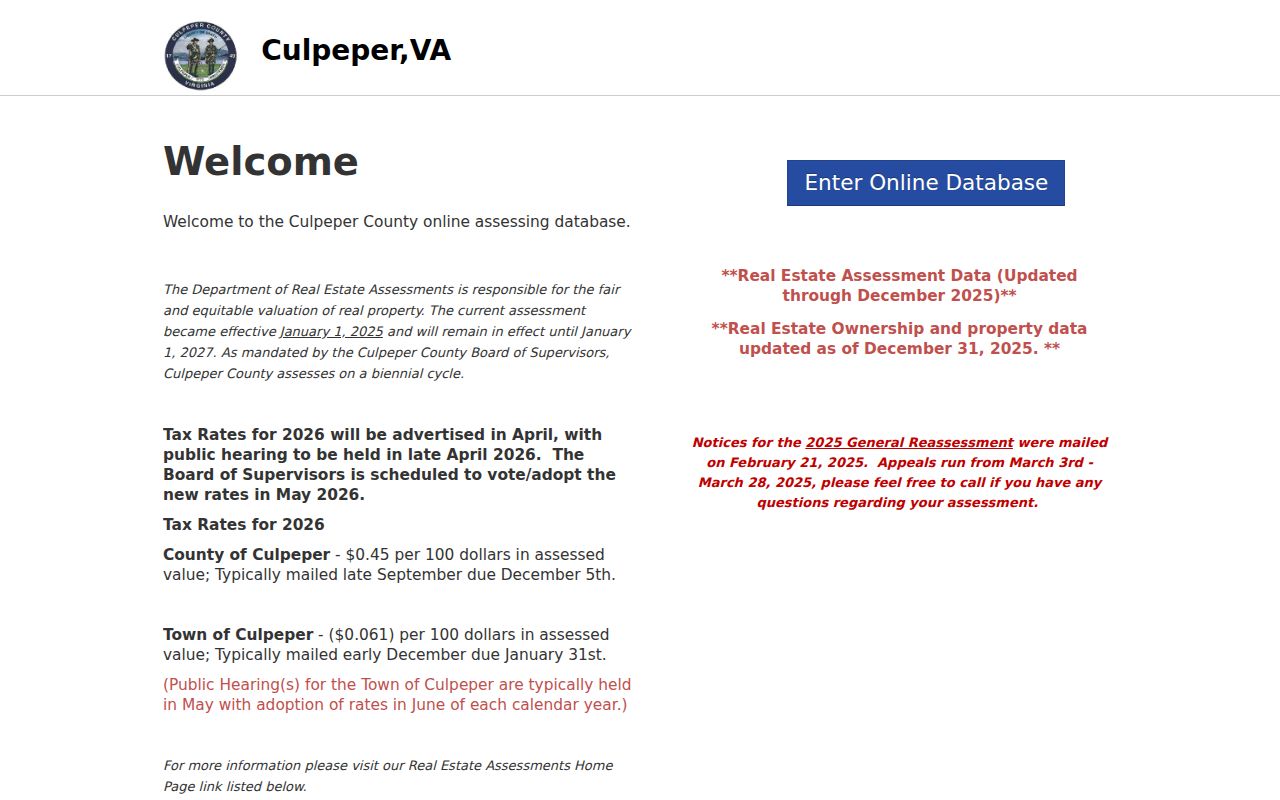
The tax roll alone is not the last word. Use the parcel key to check the same name in the deed index.
Entity Names in Culpeper County Records
The grantee of record may be a company. Someone else may manage or occupy the land. Search the company's full legal name in both the parcel roll and the deed index. Include the punctuation and suffix. Virginia's SCC Clerk's Information System shows entity status, registered agent, principal office, and filing history. Those fields explain a company name. They do not prove who controls the parcel.
Trusts may be indexed under a trustee, the trust name, or both. Estates often list an executor or administrator. A life estate can leave a remainder interest in another name. When names differ, match the deed's legal description and parcel key before drawing any conclusion. The Virginia SCC entity search is the official company lookup.
Records That Name a Culpeper County Owner
Different records answer ownership differently. The assessment roll gives the quickest owner-of-record clue. The deed shows the grantee the Clerk recorded. GIS links each tax parcel to its spot on the map. A Treasurer ticket matches an account by GPIN, but it is a tax record rather than a title document. The county's systems connect by parcel and name alone. No single record settles who owns a Culpeper County property; the answer depends on which record and which date are checked.
| Source | Owner Info It Gives | Access |
|---|---|---|
| Vision assessment roll | Owner name, mailing/situs clues, GPIN, assessment | Public web lookup |
| Circuit Court Clerk / SRA | Grantor and grantee in recorded instruments | Index may be free; images require local authorization |
| County GIS | Parcel location, owner and acreage as published | Public map; exact tools not verified |
| Treasurer inquiry | Ticket tied to Account, GPIN, or street | Public inquiry; street search omits number |
"Owner of record" means the name shown in a public record. It says nothing about who is present. The mailing address can be a tax-notice stop. It may instead point to an attorney, a trustee, or an entirely separate home. Compare the roll with the latest deed before treating a name as current.
Land records live with the Circuit Court Clerk. They include deeds, deeds of trust, plats, and judgments, along with the wills and marriage records the Clerk also keeps. A will or probate entry explains an estate name. The conveying instrument still needs identifying. A missing online result proves little. It is a reason to ask the Clerk about paper or archived records rather than assume no transfer occurred.
A company holding changes the picture. The Virginia SCC record supplies entity context such as status, registered agent, principal office, and filings. Registered agents accept official notices. That role alone does not show who owns the land or who lives there. Match the company name to the deed's grantee first. Then tie any person in an entity filing to a specific Culpeper County parcel through the legal description.
Culpeper County Property Owner Clues in Situs and Mailing Fields
Situs and mailing fields answer different questions. The situs address fixes where the parcel sits. The mailing address is where the Treasurer sends the tax bill. The two often differ. A Culpeper County owner of record may list a home, business, attorney, or trustee address elsewhere. Rural tracts add quirks. Expect a route or box number, a newer 911 address, or a mailing city outside the government boundary. Pin the tract with the situs field and the GIS map. Treat the mailing entry as tax-roll context only.
Neither field tells you who occupies the property today. If an address search comes up empty, try the owner name or ask for the GPIN. Older deeds and plats may describe a parcel by acreage, adjoining owners, roads, or streams instead of a street number. Those deed details make stronger match clues. They beat any guessed modern address in Culpeper County property records.
Town Parcels in Culpeper County Ownership Records
Town of Culpeper parcels stay inside the county's own systems. The assessor, Treasurer, Circuit Court Clerk, and GIS all carry them. The split shows up in land use. Town Planning handles permits and zoning within the corporate limit. County development rules leave that land out. A Culpeper mailing address alone will not settle which office governs a property.
Start with the county GPIN to identify the parcel. Then compare the GIS polygon against the Town boundary. Call Planning when a tract sits near the edge. The Town's applicant PDF is a permit-intake form, not a searchable historic case database. It captures address, owner and contact, contractor, activity, and estimated cost fields. For an older zoning or permit file, ask Town Planning & Community Development. They can run an address-based search.
Culpeper County Property Ownership and Recorded Interests
A current grantee name never tells the whole property story. The Clerk's records may also hold a deed of trust, assignment, or release. They may also hold an easement, judgment lien, mechanic's lien, or lis pendens. A purchase or boundary question calls for due diligence. Search the party names and parcel description. The county offers no property-fraud alert signup, so assume no notification service exists.
Probate can explain an odd deed record. Say a Culpeper County owner died. The estate may have transferred title through an administrator deed. A death certificate proves the event, but it does not convey title itself. The Clerk's probate file plus the recorded deed are the sources to check. Need a deeper look at the current owner-of-record field? See the Culpeper County current owner record page.
Property disputes also generate court records. Foreclosure, partition, quiet-title, boundary, mechanic's-lien, and deed-correction matters all leave files behind. Statewide Virginia case information does not cover every locality's circuit-court docket. Bring a known case number or party name to the local Clerk. Then confirm through the land-record index whether a later deed was recorded in Culpeper County property records.
Limits of a Culpeper County Owner Lookup
A public record names the owner attached to a deed or tax account. It cannot confirm occupancy. It cannot confirm possession or every private arrangement. Virginia's Address Confidentiality Program lets protected participants use a substitute address on the tax roll. Never publish a protected location or use owner details to approach or target a person.
Lawful use. Use Culpeper County owner information for property diligence, title research, and civic review. Do not use it to stalk, threaten, or harass anyone.